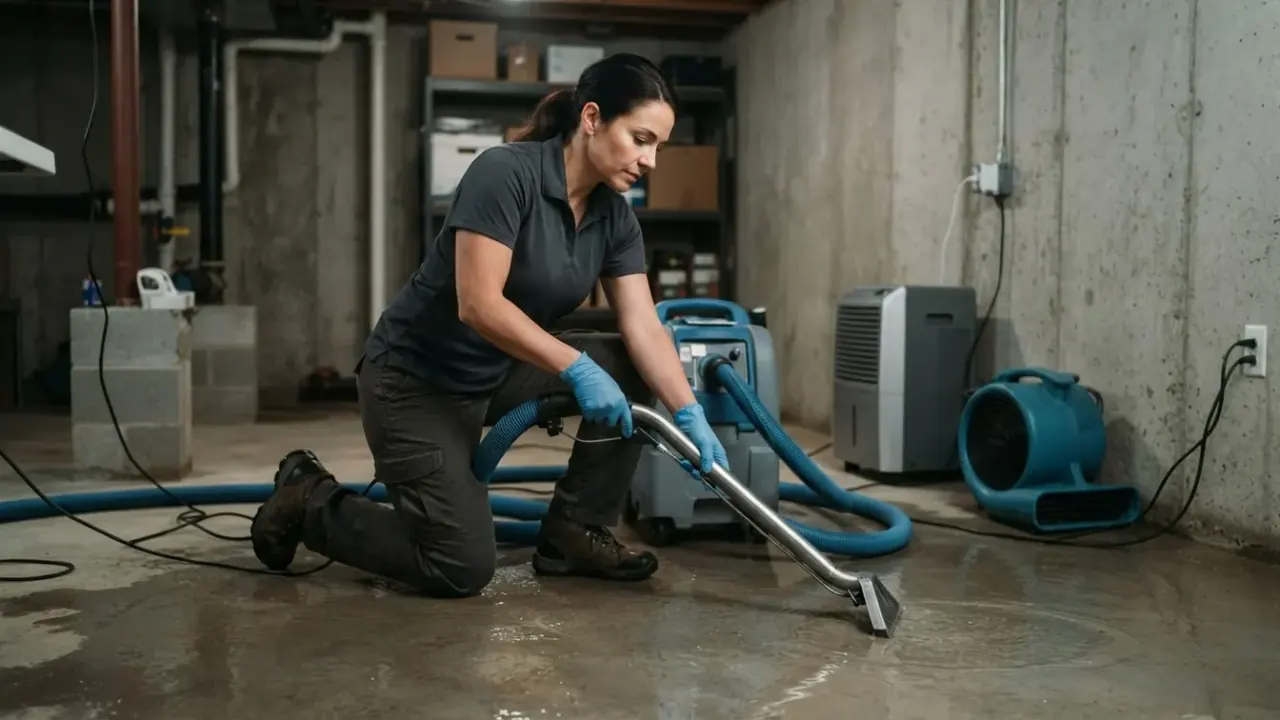
To dry out a wet basement after water extraction, you need to remove all standing water first, then run high-capacity dehumidifiers and air movers for 3 to 5 days while monitoring moisture levels daily. In Frisco, Texas, where humidity often stays above 60% in summer, that drying window can stretch to a week if the space has no ventilation. This guide covers the exact steps, equipment, and timelines we use on basement water removal jobs across Frisco.
Water extraction is only the first half of the job. The second half - drying - is what determines whether you end up with a musty smell, warped baseboards, or a mold problem three weeks from now. We have seen too many homeowners in Frisco pull out a shop vac, call it done, and then pay thousands for mold remediation later. Here is how to do it right.
Why Drying After Extraction Matters in Frisco
Drying after extraction matters in Frisco because the local climate and soil conditions keep basement materials wet far longer than most homeowners expect. Frisco sits on expansive clay soil that holds water against foundation walls long after the rain stops. That means even after you extract the visible water, moisture keeps wicking through concrete and into drywall, framing, and carpet padding.
Mold can begin growing on wet drywall in as little as 24 to 48 hours. In a Frisco basement with no dehumidification, relative humidity can stay above 70% for days, which is prime mold territory. The difference between a $500 drying job and a $5,000 mold remediation often comes down to how fast you get the space below 50% humidity.
We handle water damage restoration Frisco TX calls every week where the homeowner did extract the water but skipped the drying phase. The water was gone. The damage was not.
How Long Does It Take to Dry a Wet Basement in Frisco TX?
Most wet basements in Frisco dry in 3 to 5 days with professional equipment, but that timeline depends on three factors: how much water was absorbed, what materials got wet, and how much airflow the space gets. A concrete-floor basement with minimal drywall contact can dry in 48 to 72 hours. A finished basement with carpet, pad, and insulated walls often needs 5 to 7 days.
Here is what we typically see on Frisco jobs:
- Unfinished basement, concrete floor: 2 to 3 days with 2 dehumidifiers and 4 air movers.
- Partially finished, drywall lower 2 feet wet: 4 to 5 days, plus drywall removal below the water line.
- Fully finished with carpet and pad: 5 to 7 days, and carpet pad almost always gets replaced.
- Basement with no ventilation and high outdoor humidity: add 1 to 2 days.
We measure moisture content in the framing and drywall daily. When readings hit 12% to 15% for wood and under 1% for drywall, the structure is dry. Guessing by touch is how homeowners end up with hidden mold behind baseboards.
If you are in water damage Frisco Square TX, where many basements are partially below grade and share walls with garages, drying can take longer because of limited cross-ventilation. We adjust equipment counts for those layouts.
What Equipment Is Needed to Dry a Basement in Frisco?
You need three categories of equipment to dry a basement properly: water extraction tools, air movement, and dehumidification. Skipping any one of them leaves moisture behind.
Extraction equipment: A wet/dry shop vac works for small puddles, but a truck-mounted or portable extraction unit pulls water from carpet and pad far more effectively. If you had more than an inch of standing water, a sump pump or utility pump is faster than a shop vac.
Air movers: These are high-velocity fans designed to move air across wet surfaces and accelerate evaporation. You want one air mover for every 10 to 15 feet of wall space, angled along the wall, not pointing at the floor. Box fans do not cut it - they move air but not with enough force to break the boundary layer of moisture on concrete.
Dehumidifiers: This is the piece most homeowners skip. A standard residential dehumidifier pulls 30 to 50 pints per day. A professional-grade unit pulls 100 to 150 pints per day and can hold humidity at 40% to 45% in a 1,000-square-foot basement. For a wet basement in Frisco, you need the larger unit. We use dehumidification Frisco TX equipment sized to the cubic footage of the space, not the square footage.
If your water came from a sewage backup or a toilet overflow, the cleanup is different - that water is contaminated, and you need sewage backup cleanup Frisco TX before any drying equipment goes in.
Step-by-Step: How to Dry Out a Wet Basement After Water Extraction in Frisco
Here is the exact sequence we follow on basement water extraction and drying jobs in Frisco. You can replicate most of it with rented equipment if you catch the water early.
1. Remove all standing water and wet items
Before any air moves, get the water out. Use a pump or extraction unit for standing water. Pull up any loose rugs, cardboard boxes, and stored items. If carpet pad is soaked, cut it out and throw it away - pad does not dry effectively and will grow mold.
2. Set up containment if mold is likely
If the water sat for more than 48 hours, assume mold spores are present. Hang plastic sheeting to separate the wet area from the rest of the house. Run a HEPA air scrubber if you have one. This keeps spores from spreading to your HVAC system.
3. Position air movers along the walls
Angle air movers so they blow air along the base of the wall, not across the room. Moisture wicks up drywall and framing from the bottom. You want airflow hitting that lower 2 feet of wall where the water climbed. Run them 24 hours a day - turning them off at night slows drying and lets moisture settle back into materials.
4. Run dehumidifiers continuously
Place dehumidifiers in the center of the space, away from walls. Set them to maintain 40% to 45% relative humidity. Empty the reservoir or run a hose to a drain - if the unit shuts off because it is full, you lose hours of drying time. In Frisco's summer humidity, we often run two units in a 1,000-square-foot basement.
5. Monitor moisture daily
Use a moisture meter on drywall, wood framing, and concrete. Write down readings each day. You are looking for steady decline. If a reading has not dropped in 24 hours, something is still wet - often the wall cavity or under the floor. Do not stop drying based on how the room feels. Stop when the meter says the materials are dry.
6. Address the source before you finish
Drying a basement that will flood again next month is a waste of money. If the water came from a failed sump pump, we handle sump pump failure cleanup Frisco TX and can recommend a backup system. If it came from a burst pipe, the pipe needs repair before drying is complete.
Common Mistakes to Avoid When Drying a Wet Basement
The most common mistake we see in Frisco is stopping the drying process too early. Homeowners feel dry air, assume the job is done, and turn off the equipment. Two weeks later, they smell mold.
Other mistakes that cost real money:
- Using box fans instead of air movers. Box fans move air but do not generate the velocity needed to pull moisture out of concrete and framing.
- Skipping the dehumidifier. Air movers without dehumidification just move moisture around the room. You need to remove it from the air.
- Leaving wet carpet pad in place. Pad is a sponge. It will not dry in a basement, and it will grow mold.
- Not checking wall cavities. Water wicks up inside walls. If the drywall feels dry on the surface but the baseboard is soft, the cavity is still wet.
- Turning off equipment at night. Drying is a 24-hour job. Every hour off is an hour of moisture settling back into materials.
- Ignoring the HVAC system. If your air handler or ductwork got wet, running the AC spreads mold spores through the house.
We also see homeowners in water damage Stonebriar TX try to dry basements without addressing the grading outside. If water pools against the foundation, it will find its way back in. Drying is temporary if the source is not fixed.
Prevent Mold After Basement Water Extraction in Frisco TX
Mold prevention after basement water extraction in Frisco comes down to speed and humidity control. Mold needs three things: moisture, organic material (drywall paper, wood, dust), and time. Remove the moisture fast enough and mold never gets started.
Here is what we do to prevent mold on every job:
- Get the space below 50% relative humidity within 48 hours of extraction.
- Remove and replace any drywall that was wet above the water line for more than 24 hours.
- Apply an antimicrobial treatment to framing and concrete after drying is complete.
- Run a HEPA air scrubber during the drying process to capture airborne spores.
- Schedule a mold inspection Frisco TX if the water sat for more than 48 hours or if you smell anything musty after drying.
If you had sewage water in the basement, mold prevention is not optional - that water carries bacteria that can make you sick. We treat those jobs as contaminated water events from the start.
When to Call a Professional
Call a professional when the water covered more than a small area, when it sat for more than 24 hours, or when the basement is finished with drywall and carpet. Those three conditions almost always mean hidden moisture that a shop vac and a box fan cannot reach.
We also get calls when homeowners have dried the basement themselves but still smell something musty a week later. That smell is mold. At that point, drying is no longer the issue - remediation is.
Restoration Solutions handles basement water removal and drying across Frisco. We bring the extraction equipment, the air movers, the dehumidifiers, and the moisture meters. We monitor daily and do not call the job done until the readings say it is dry. If you are dealing with a wet basement right now, we can walk you through what to do next.
Frequently Asked Questions
How do I dry out my wet basement after water extraction in Frisco?
Remove all standing water, then run high-capacity dehumidifiers and air movers continuously for 3 to 5 days. Keep humidity below 45% and monitor moisture readings daily. In Frisco's humid climate, most basements need at least two dehumidifiers and four air movers to dry properly.
How long does it take to dry a wet basement in Frisco TX?
Most Frisco basements dry in 3 to 5 days with professional equipment. Finished basements with carpet and drywall often take 5 to 7 days. If the space has poor ventilation or the outdoor humidity is high, add 1 to 2 days to that timeline.
What equipment is needed to dry a basement in Frisco?
You need a water extraction unit or pump, high-velocity air movers (one per 10 to 15 feet of wall), and a professional-grade dehumidifier that pulls 100 to 150 pints per day. A moisture meter is also essential to confirm the structure is actually dry, not just dry to the touch.
Can a wet basement cause mold in Frisco homes?
Yes. Mold can start growing on wet drywall in 24 to 48 hours. Frisco's humidity often keeps basements above 70% relative humidity for days after a leak, which is ideal for mold growth. Fast drying and antimicrobial treatment are the best prevention.
Who does basement drying near me in Frisco?
Restoration Solutions provides basement drying and water damage restoration throughout Frisco, including Frisco Square, Stonebriar, and surrounding neighborhoods. We handle extraction, drying, dehumidification, and mold inspection. Call 469-898-0122 for help.
Get Help with Water Damage in Frisco
If your basement is still wet or you are not sure the drying job is finished, we can help. Restoration Solutions serves Frisco and the surrounding areas with professional water extraction, structural drying, and mold prevention.
Call us at 469-898-0122 and we will get your basement dry and keep it that way.