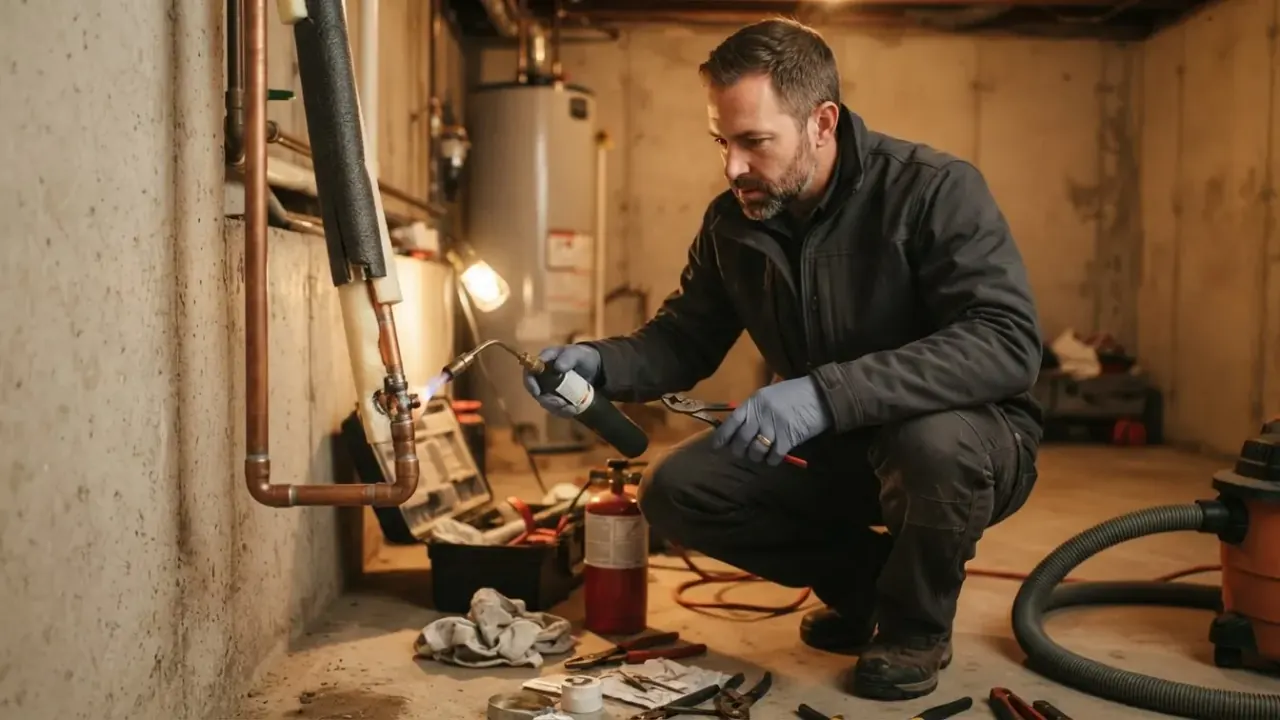
Frisco pipes burst when water inside them freezes, expands about 9 percent, and splits the copper or PVC from the inside out. The split usually stays hidden until the ice thaws, which is why the worst damage happens the morning after a hard freeze, not during it. Preventing that split comes down to four things: keeping the pipe above 32°F, relieving pressure with a drip, sealing the cold air out of the crawlspace or attic, and knowing exactly what to do the moment a faucet stops flowing. This guide covers each one for Frisco homes, plus the mistakes we see most often when we respond to water damage Frisco TX calls in January and February.
Why Frisco pipes freeze so fast
Frisco sits in Collin County on the Blackland Prairie, where winter nights routinely drop from a 60°F afternoon to 18°F by 3 a.m., and that 40-degree swing is what cracks pipes. North Texas homes are built for 100°F summers, not single-digit wind chills, so builders run supply lines through unconditioned attics, exterior walls, and garage slabs. When the wind switches to the north at 25 mph, those cavities lose heat fast.
Two other local factors matter. First, Frisco's clay soil shifts with moisture, and a small foundation movement can open a gap at the sill plate where cold air pours into a wall cavity. Second, most homes here have a slab-on-grade foundation with the main line entering through the garage wall, which is the single most common freeze point we find. If your home was built before 2010, the exterior hose bibs are probably the non-freeze type but the interior shutoff may not exist.
We see the same pattern in every neighborhood. In water damage Frisco Square TX condos, the freeze point is usually the fire-sprinkler line in an unheated stairwell. In larger subdivisions, it's the attic run above the master bath. Knowing your home's weak spot is half the battle.
What temperature do pipes freeze in Frisco TX?
Water freezes at 32°F, but pipes in Frisco homes start to rupture when the air around them holds at 20°F or below for four to six hours. The pipe doesn't have to be full of ice to break. A partial freeze creates a pressure spike between the ice plug and the closed faucet, and that spike can hit 2,000 psi, which is far more than copper or CPVC can handle.
Wind chill accelerates the process. A 20°F night with a 20 mph north wind pulls heat out of an exterior wall about twice as fast as still air at the same temperature. That's why a two-hour freeze warning in Frisco is worth taking seriously. The National Weather Service issues a hard freeze warning when the temperature is forecast to stay at or below 28°F for at least two hours, and Collin County averages 12 to 18 such nights between December and February.
How to prevent frozen pipes in Frisco winter
Frozen pipes prevention Frisco homeowners can do themselves starts with four habits that cost almost nothing and take about 20 minutes to set up. Do these before the first hard freeze, not during it.
1. Let the faucets drip
Open the cabinet doors under every sink on an exterior wall and let the hot and cold sides drip at the rate of a pencil lead. A steady drip keeps water moving, and moving water needs a lower temperature to freeze than standing water. The cost is roughly $3 to $8 per night in extra water, which is nothing compared to a $4,000 to $12,000 pipe burst cleanup. The two faucets that matter most are the one farthest from where the main line enters the house and any sink on a north-facing wall.
2. Insulate pipes Frisco style
Foam pipe sleeves from any Frisco hardware store cost about $1.50 per six-foot section. Wrap every exposed copper or PEX line in the attic, garage, and crawlspace, then seal the seams with foil tape. For pipes in an exterior wall, the sleeve alone won't help much because the cold air is on the other side of the drywall. In that case, the fix is to air-seal the wall penetration with spray foam and add a fiberglass batt behind the pipe. We've seen a $40 insulation job prevent a $9,000 loss more than once.
3. Seal the cold air out
Walk the exterior of your home and look for gaps around the foundation, the dryer vent, the AC line set, and the hose bibs. A 1/4-inch gap at the sill plate is enough to freeze a pipe two feet away. Use expanding foam or caulk rated for exterior use. Also check the attic access panel and any whole-house fan damper; an open damper turns the attic into a wind tunnel.
4. Disconnect and drain outdoor lines
Remove every garden hose, then close the interior shutoff valve for the hose bibs and open the exterior spigot to drain the line. If your home doesn't have an interior shutoff, install a freeze-proof sillcock, which costs about $30 in parts and is a 30-minute job for a plumber. Irrigation systems need the same treatment: shut off the backflow preventer, drain the zones, and blow the lines with compressed air.
How do I thaw frozen pipes in Frisco without bursting them?
Thaw a frozen pipe slowly from the faucet end back toward the frozen section, using a hair dryer on low, a heat lamp, or a space heater with a fan. Never use an open flame, a propane torch, or a heat gun on high, because those can flash-steam the water inside and split the pipe instantly. Start at the fixture and work backward so the melting water has somewhere to go.
Here's the sequence we walk homeowners through on the phone:
- Shut off the main water valve if you see any water escaping.
- Open the affected faucet so melted water and steam can escape.
- Apply gentle heat to the pipe, moving the source constantly.
- Check for leaks every few minutes as the ice clears.
- If the pipe doesn't flow within 45 minutes, stop and call us.
If you can't reach the frozen section, or if the pipe is inside a wall, don't cut the drywall yourself. We locate the freeze point with a thermal camera, thaw it safely, and check the line for splits before we leave. That's the same process we use on pipe burst cleanup Frisco TX calls, and it's why most of our freeze jobs are finished in under three hours.
What to do if pipes freeze in Frisco TX
If you turn on a faucet and nothing comes out, the pipe is frozen somewhere between the main and that fixture. The first thing to do is shut off the main water valve, because the ice plug is holding back pressure that will release the moment it thaws. Then open the nearest faucet to relieve pressure, and start thawing.
Watch for these signs that the pipe has already split:
- Water staining on drywall or ceiling, especially near an exterior wall.
- A hissing or dripping sound inside a wall cavity.
- The water meter spinning with every fixture closed.
- Warm or damp spots on the floor near the water heater or garage wall.
If you see any of those, you have a burst, not just a freeze. Shut off the main, call us, and start moving furniture and valuables out of the path of the water. We handle the extraction, the drying, and the repairs, and we can be on-site in Frisco within about 60 minutes for emergencies.
For homes in older neighborhoods like water damage Preston Ridge TX, where the original 1990s copper is now 30 years old, a freeze event often turns into a pinhole leak even after the thaw. We pressure-test the line after every freeze call for exactly that reason.
Common mistakes that cause burst pipes
The same five mistakes cause most of the winter pipe bursts we clean up in Frisco, and every one of them is avoidable.
- Leaving the garage door open overnight. The garage is the coldest room in the house, and the main line often runs through it. Close the door before bed on any night below 30°F.
- Turning the heat down too far while traveling. Don't set the thermostat below 55°F, even if you're gone for two weeks. The savings aren't worth the risk.
- Using a torch to thaw a pipe. Every year we see a house fire started this way. Use a hair dryer or heat lamp instead.
- Forgetting the attic. Attic supply lines are the number one freeze point in Frisco homes built after 2005, because builders run them above the insulation.
- Ignoring a slow drain. A partially blocked drain can freeze and crack a trap. If a sink drains slowly in December, snake it before the first hard freeze.
One more: don't assume a newer home is safe. We've responded to freeze damage in homes less than five years old in water damage Phillips Creek Ranch TX, usually because the builder left an attic line uninsulated. Age of the home is not protection.
When to call a professional
Call a professional the moment you see water where it shouldn't be, smell musty air after a freeze, or can't get a frozen line to thaw within an hour. Those three signals mean the pipe has likely split, and every minute of standing water raises the chance of mold, warped hardwood, and ruined drywall.
Our team handles the whole chain: we find the break, stop the water, extract what's already on the floor, dry the structure, and repair the pipe and the drywall. We use truck-mounted extraction and commercial dehumidifiers, and we monitor moisture daily until your home reads dry on our meters. If you've already had a freeze event this season, we can also do a whole-home pipe inspection and insulation check so the next cold snap doesn't catch you the same way.
If the water reached the basement or a lower level, we treat it as a basement water removal Frisco TX job and bring in the larger pumps. Either way, the goal is the same: dry floors, dry walls, and a pipe that holds pressure.
Frequently Asked Questions
How do I prevent frozen pipes in Frisco winter?
Let exterior faucets drip, insulate exposed lines in the attic and garage, seal air gaps at the foundation, and keep the thermostat at 55°F or higher. Disconnect hoses and drain outdoor spigots before the first hard freeze, which in Frisco usually arrives in mid-December.
What temperature do pipes freeze in Frisco TX?
Water freezes at 32°F, but pipes in Frisco homes typically rupture after four to six hours at 20°F or below. Wind makes it worse. A 20°F night with a 20 mph north wind can freeze an exterior wall pipe in about half the time.
What should I do if my pipes freeze in Frisco?
Shut off the main water valve, open the nearest faucet to relieve pressure, and thaw the pipe slowly with a hair dryer or heat lamp. If nothing flows within 45 minutes, or you see water staining, call us at 469-898-0122.
How do I thaw frozen pipes in Frisco without bursting them?
Heat from the faucet end back toward the frozen section using a hair dryer on low or a space heater with a fan. Never use a torch or open flame. Move the heat constantly and check for leaks every few minutes as the ice clears.
Who do I call for frozen pipe repair in Frisco?
Call Restoration Solutions at 469-898-0122. We handle emergency frozen pipe repair, water extraction, structural drying, and drywall repair in Frisco and the surrounding Collin County area, and we're typically on-site within about 60 minutes.
Get help with water damage in Frisco
If a pipe has already burst, or you're not sure whether it has, don't wait for the thaw to find out. We handle frozen pipe repair, water extraction, and full drying for Frisco homeowners, and we can be at your door fast.
Call 469-898-0122 now and we'll walk you through shutting off the water while our crew heads your way.